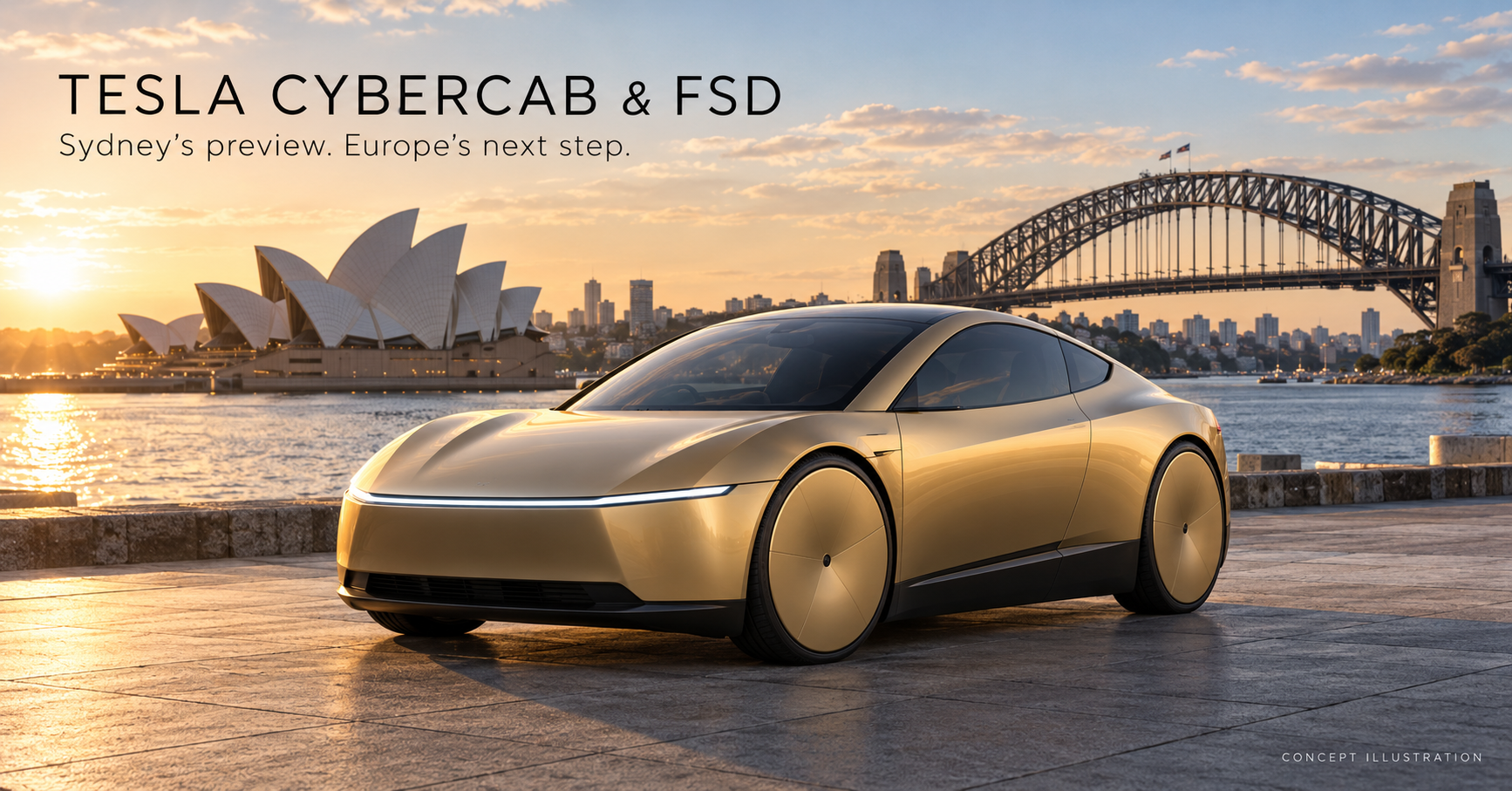
Tag: Sydney Cybercab

  • Tesla Cybercab overtakes Model Y on the Texas robotaxi register as Tesla FSD gains approval in Latvia

    Tesla Cybercab overtakes Model Y on the Texas robotaxi register as Tesla FSD gains approval in Latvia

    2 November 2026 | Reporting week: 26 October–1 November 2026

    Tesla can build Cybercabs faster than it can put them into service. That was the message from vehicle engineering chief Lars Moravy in a Munro Live factory tour released on 26 October. A day later, Texas registration figures put the shift into focus: 544 Cybercabs and 507 Model Ys. For the first time, the purpose-built two-seater accounted for more than half of Tesla’s registered robotaxi fleet in the state. TeslaNorth.com

    Texas has more Cybercabs than places to hail one

    Moravy explained that Tesla does not run the Cybercab line every day because production is already ahead of deployment. Engineers assemble and test major sections separately before bringing them together at 25 automated final assembly stations. The factory can add vehicles faster than the ride service can absorb them. TeslaNorth.com

    Herbert Ong’s 30 October CyberBulls episode, featuring Cern Basher, highlighted 81 Cybercab registrations in a single day. That helps explain how quickly the fleet mix changed. Where can passengers actually book one? Tesla’s rider guide still lists limited areas of Austin. Dallas already has Model Y robotaxis; its previously announced November Cybercab target had no confirmed public launch by 1 November. Apple Podcasts

    Houston gets a bigger map; riders get a later last call

    Houston’s robotaxi service area expanded on 26 October to an estimated 254 square miles (658 km²), according to Robotaxi Tracker figures reported by Tesla News Wire. By 29 October, new users in Houston and Dallas were also seeing a first ride priced at US$0. Both changes applied to cities served by Model Ys. Tesla News Wire

    Tesla’s official Robotaxi update, reported on 30 October, listed 6am–2am operating hours without specifying every market covered. Passengers also gained a rear-camera view, a useful addition in a Cybercab with no rear window. A new Calm Mode lets them hide the on-screen driving visualisation. Not a Tesla App

    Supervised FSD reaches more drivers

    On 26 October, Tesla Europe announced that Latvia had approved Tesla Assisted Driving, the European name for Full Self-Driving (Supervised). Latvia was the tenth European country to approve it. Tesla said rollout would follow; approval alone did not switch it on in every eligible car. reuters.com

    In North America, the rollout of software 2026.38.5.11 widened, delivering FSD v14.3.13 to Hardware 4 vehicles and v14.3 Lite to older Hardware 3 cars. From 28 October, Turo’s US marketplace also began identifying eligible rentals with an active FSD subscription. A renter can now choose a Tesla for its driving assistance; the person behind the wheel remains responsible throughout the trip.

  • Tesla Cybercab and Tesla FSD: customer sales move closer as robotaxi ambitions grow

    Tesla Cybercab and Tesla FSD: customer sales move closer as robotaxi ambitions grow

    26 October 2026 | Reporting period: 19–25 October 2026

    Tesla put fresh dates against its autonomous-driving ambitions this week: initial Cybercab customer deliveries targeted before year-end, Dallas Cybercab rides planned for November, and unsupervised driving in customer cars tentatively pencilled in for the second quarter of 2027. Its earnings update also supplied something more immediate: evidence that supervised FSD is becoming a stronger selling point. Reuters

    FSD becomes part of the buying decision

    In its 21 October quarterly update, Tesla reported FSD attachment on more than 75% of new North American deliveries, up nearly 20 percentage points from the previous quarter. Tesla described FSD as a driver of vehicle demand.

    The same update reported nearly two million cumulative unsupervised robotaxi miles by the end of September, eight times the previous quarter-end total. Those figures describe two different businesses: driver assistance sold to car owners, and autonomous rides delivered through Tesla’s operated service.

    The distinction matters. Buying FSD Supervised still requires active driver supervision; it does not turn a privately owned Tesla into a driverless taxi. assets-ir.tesla.com

    Cybercab ownership gets a timetable

    AI illustration of a Tesla Cybercab’s two-seat cabin, central touchscreen and steering-wheel-free dashboard

    On the earnings call, engineering chief Lars Moravy said Tesla was trying to deliver its first Cybercabs to customers before the end of 2026, beginning on a small scale. Elon Musk nevertheless expects most Cybercabs to remain Tesla-owned or be offered as a transport service. Reuters

    Ashok Elluswamy separately put unsupervised FSD in customer vehicles at approximately Q2 2027. Tesla also envisages eligible customer cars joining its robotaxi network around then, subject to operating-area and fleet-management requirements. These are targets, not capabilities already delivered to owners. Plans also include broader weather coverage, highways and round-the-clock service. Not a Tesla App

    For readers considering a Sydney fleet, those US plans provide milestones to watch—not an Australian purchasing or launch date.

    More territory, and clearer safety definitions

    Tesla identified Las Vegas, Jacksonville, Phoenix and San Antonio as forthcoming robotaxi markets. Cybercab availability remains distinct from the wider Model Y service. Tesla Oracle

    In Austin, an app-map expansion reported on 23 October extended towards the Circuit of the Americas, alongside 1am operating hours. Some users still encountered blocked bookings to the venue, so a larger map did not guarantee every destination was immediately bookable. Tesla Oracle

    Tesla’s newly public Robotaxi Safety Report covers 22 January–18 October, excluding trips with an onboard safety monitor. It reports no robotaxi airbag deployments or pedestrian/cyclist strikes under its definitions.

    Those definitions deserve attention: its injury and pedestrian/cyclist measures count collisions where the robotaxi made first contact. The human comparison does not apply that same filter. The results offer useful operational evidence, but do not establish a simple, like-for-like safety multiple over human drivers. Tesla

    The investment case still depends on execution

    Cathie Wood’s ARK Invest made that dependence explicit in its 19 October valuation model: robotaxis account for roughly 80% of its projected 2031 Tesla enterprise value, underpinning an expected US$4,400 share price. That is an investment forecast, not Tesla guidance. ark-invest.com

    Herbert Ong’s updated catalyst guide supplies a useful practical counterweight: earnings show whether margins and cash flow can fund the autonomy ambitions. The next test is turning this week’s timetables into customer deliveries, reliable services and a repeatable business.

  • Tesla Cybercab and Tesla FSD: longer Austin hours, wider access and fresh scrutiny

    Tesla Cybercab and Tesla FSD: longer Austin hours, wider access and fresh scrutiny

    19 October 2026 | Reporting period: 12–18 October 2026

    Tesla’s autonomy ambitions became a little more practical this week: Austin robotaxi customers gained later rides, while more owners of older Teslas gained access to newer supervised driving software. Alongside that expansion came fresh scrutiny of how the vehicles behave on real roads.

    Austin gets another hour

    Tesla’s Austin Robotaxi service now operates from 6am to midnight, according to an app notification reproduced in reporting published on 17 October. That extends the previous 11pm finish, making the service more useful for evening trips. Not a Tesla App

    The commercial implication is straightforward: longer hours give each vehicle more opportunities to carry paying passengers. They do not, by themselves, establish profitability or mean round-the-clock service has arrived.

    That distinction sits alongside the question posed in Cern Basher’s 13 October article, “Tesla May Care More About Revenue Per Hour Than Revenue Per Mile”. X

    Older Teslas receive FSD Lite

    On 14 October, Tesla announced that FSD Supervised v14 Lite was rolling out to Intel-equipped Model S and Model X vehicles, according to its original post, reproduced by TeslAnt.

    This matters for owners of older Hardware 3 cars who had been waiting for the newer software branch. The installations documented in that report were in the United States and Canada; they do not establish Australian availability. TeslAnt

    “Supervised” remains the crucial word. This consumer software requires an attentive driver and should not be confused with driverless Cybercab operation.

    Europe also moved forward. On 16 October, Tesla Europe announced Slovakia’s approval of its supervised system, marketed there as Tesla Assisted Driving, with rollout still to come. The announcement concerns driver assistance, not permission for a driverless robotaxi network. Not a Tesla App

    Safety reporting deserves the same attention

    NHTSA crash data published on 15 October brought earlier incidents into view. Tesla News Wire’s analysis counted nine Tesla robotaxi crashes in August, with no reported injuries, including the first Cybercab entry.

    That Cybercab reportedly encountered a water-filled pothole in an Austin car park with a safety monitor aboard and no passengers. The incident preceded September’s public rides. teslanewswire.com

    These are reports of incidents, not a meaningful safety rate on their own. NHTSA cautions that the data have limitations; raw totals cannot establish how Tesla compares with human drivers without comparable exposure and reporting measures. NHTSA

    Separately, reporting on 12 October drew attention to defect petition DP26010, opened on 9 October, alleging robotaxis exceeded speed limits in active school zones. NHTSA is evaluating whether to grant the petition. That is not a recall or a finding that the allegations are proven. api.nhtsa.gov

    For prospective operators, the week offered both a more useful service and a reminder of what must underpin its expansion: dependable performance, transparent evidence and permission to operate in each market.

  • Tesla Cybercab and Tesla FSD: Austin fleet passes 300 as Dallas moves into view

    Tesla Cybercab and Tesla FSD: Austin fleet passes 300 as Dallas moves into view

    Published 12 October 2026 | Reporting period: 5–11 October 2026

    Tesla says more than 300 Cybercabs are now serving Austin, its clearest update yet on the scale of the purpose-built robotaxi fleet. With Dallas flagged as the next destination, the story is moving beyond the vehicle’s unusual design towards the harder question: how quickly can Tesla build a dependable transport service across multiple cities? Not a Tesla App

    Meanwhile, Tesla FSD acquired a different name on European websites, and another supervised software update began reaching early users.

    Austin grows, Dallas waits

    On 10 October, Tesla’s official Robotaxi account said its Austin Cybercab fleet had expanded eightfold in 30 days to more than 300 vehicles. Tesla AI chief Ashok Elluswamy followed with two consequential words: “Dallas soon.” Not a Tesla App

    That is an announcement of intended expansion, without a launch date. Tesla’s Cybercab FAQ still identifies limited areas of Austin as the place to book Cybercab rides, while listing Dallas among cities already served by Model Y Robotaxis. Tesla Support

    Bringing Cybercab to Dallas would therefore add Tesla’s dedicated two-seater to an existing service.

    For prospective fleet operators, the Austin figure is encouraging evidence of deployment at growing scale. It does not, by itself, reveal passenger demand, paid kilometres per vehicle or profitability. Those measures will determine whether a larger fleet becomes a stronger business.

    Europe changes the name, not the driver’s role

    By 9 October, Tesla was replacing “Full Self-Driving” with “Tesla Assisted Driving” on European websites, according to Reuters. The new wording is visible on Tesla’s own German and Dutch pages. reuters.com

    The change addresses a persistent problem: a product name that can suggest more autonomy than the supervised system provides.

    Germany’s backing offered Tesla momentum this week, but Reuters reported that a wider EU approval vote had slipped to at least December. Expansion remains dependent on the approval process, rather than a single European switch-on date. reuters.com

    The safety debate also intensified. A 7 October Reuters investigation reported researchers’ objections to Tesla’s European safety evidence, including its use of surrogate measures rather than actual crash outcomes. Those objections concern how performance is demonstrated; they should not be confused with a new verdict on every FSD journey. reuters.com

    Another supervised update reaches early users

    Tesla Oracle reported on 8 October that FSD v14.3.11, delivered through firmware 2026.33.5, had begun reaching early-access HW4 vehicles the previous day.

    Its reproduced release notes were unchanged from the preceding version. That makes this a software rollout update, not evidence that every listed capability was newly introduced this week. Early driving impressions are useful observations, but cannot establish fleet-wide safety performance or Australian availability. Tesla Oracle

    Sydney sees the vehicle up close

    Tesla’s Chatswood Cybercab display ran from 5–10 October, alongside opportunities to book supervised Model 3 and Model Y test drives. Tesla Events

    For Sydney, the immediate opportunity remains seeing Cybercab and experiencing supervised driving in existing cars. Tesla’s Australian guidance explicitly requires active supervision and says FSD does not make the vehicle autonomous. Tesla Support Australia

    Austin’s expansion gives Australians a larger real-world deployment to follow. A Sydney launch date was not established by the announcements reviewed this week.

  • Tesla Cybercab and Tesla FSD: Austin runs later as Croatia approves supervised driving

    Tesla Cybercab and Tesla FSD: Austin runs later as Croatia approves supervised driving

    Published 5 October 2026 | Reporting period: 28 September–4 October 2026

    Tesla’s autonomous transport ambitions advanced in practical steps this week: Austin’s Robotaxi service extended its evening hours, Tesla announced approval for FSD Supervised in Croatia, and Sydney residents got another opportunity to inspect the Cybercab. Behind that progress sits an unusually specific engineering challenge: spotting small animals on dark roads.

    One more hour in Austin

    Tesla’s Robotaxi account announced that Austin rides would now be available until 11pm, extending the previous 10pm finish. The announcement appeared on 3 October UTC.

    Elon Musk explained that avoiding hard-to-see pets at night remained a priority, describing the difficulty of detecting grey kittens against grey tarmac. His remarks put a concrete problem behind the cautious expansion.

    For a prospective fleet operator, another service hour means another opportunity to earn revenue from the same vehicle. But an 11pm finish also shows why round-the-clock utilisation should remain an assumption to test, rather than a settled part of a Cybercab business plan.

    This update concerns Tesla’s driverless ride service in Austin. It does not turn privately owned Teslas running FSD Supervised into driverless vehicles.

    Croatia gets approval, with rollout still ahead

    On 29 September, Tesla Europe announced that FSD Supervised had been approved in Croatia, saying rollout would begin soon. Coverage reproducing the announcement identified Croatia as the eighth European country to approve the system.

    The wording matters for owners: approval opens the door to deployment, but the announcement did not say every eligible vehicle already had access. Nor was this an approval for a driverless taxi service. FSD Supervised remains a driver-assistance product requiring an attentive driver.

    Together, Austin and Croatia illustrate two different routes to expansion: extending an operating ride service and securing permission to deploy supervised software in another market.

    Sydney gets a closer look

    Tesla’s Parramatta Cybercab exhibition ran from 28 September to 4 October. Visitors could inspect the vehicle, speak with Tesla staff and book Model 3 or Model Y test drives featuring FSD Supervised.

    That offered Australians a useful distinction in person: the Cybercab was on display, while the advertised driving experience used Tesla’s existing passenger cars. The event was not an announcement of commercial Cybercab rides in Sydney.

    Looking ahead: Tesla lists the next Chatswood display for 5–10 October, at 70 Lower Gibbes Street.

    More financial flexibility, without a Cybercab spending pledge

    Tesla also disclosed US$30 billion in credit facilities in a 29 September SEC filing. The facilities comprise a US$20 billion term-loan arrangement and US$10 billion in revolving credit.

    No loans were outstanding under those facilities on that date, and Tesla said it did not currently plan to draw on them in 2026. The filing permits general corporate uses; it does not earmark the money for Cybercab. sec.gov

    For anyone following the economics of autonomous fleets, the distinction is straightforward: access to funding can support future expansion, but it is not evidence of vehicles built, paid rides completed or lower operating costs achieved.